
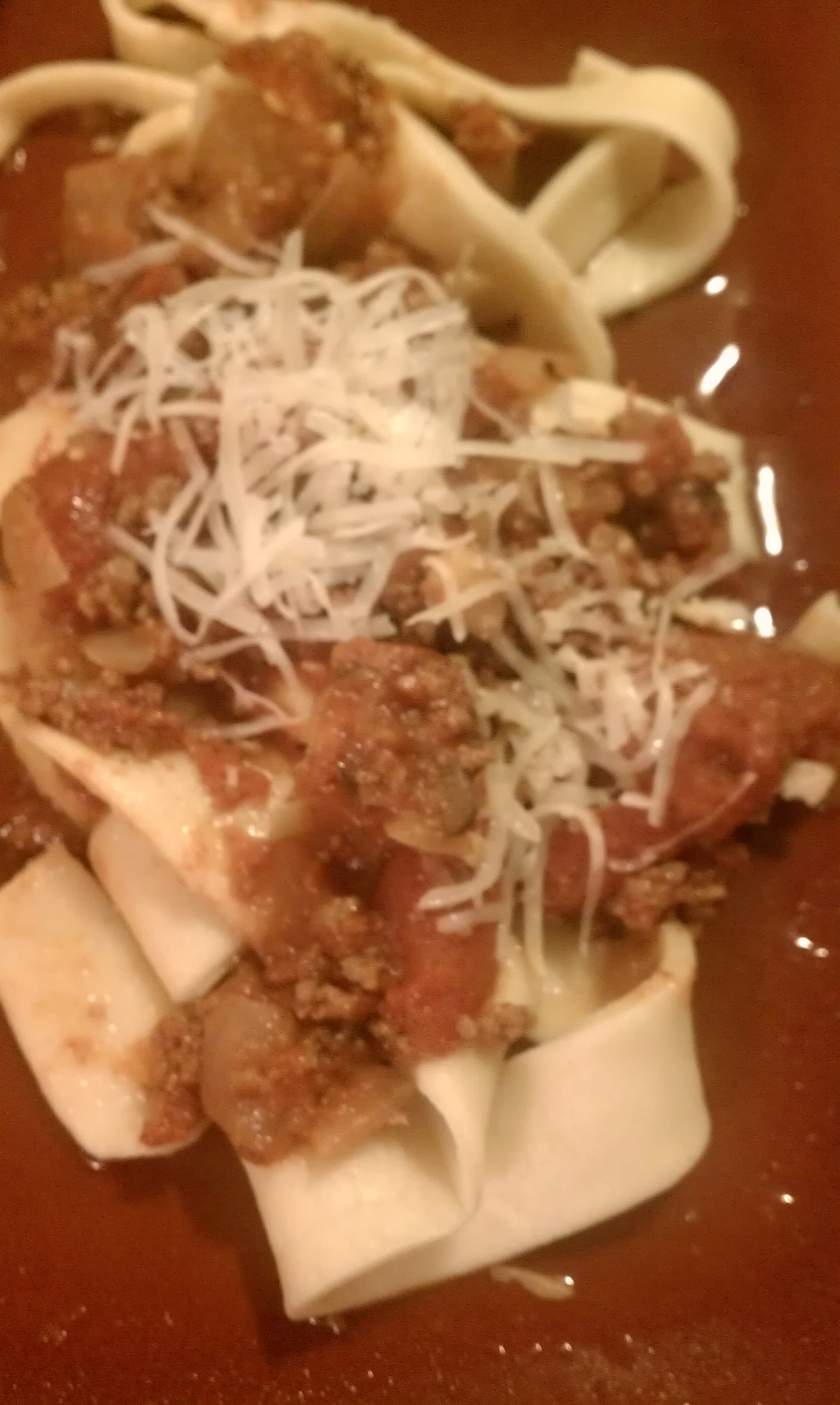
 I seem to only write about cooking successes here, filing the failures away as improvement projects to be blogged about when I figure out how to do things right.  In my defense I don’t have many out right failures.  That is to say it’s rare that I’ll cook something my roomies are unwilling to eat or that I’m unwilling to eat for lunch in the following days.  My Sunday pasta making endeavor falls into this minor failure category.
Now, when I say pasta making, I don’t mean making a pasta sauce and boiling some boxed pasta. Â I mean making the pasta myself from flour, eggs, and salt. Â All without the benefit of a pasta maker.
All around this project was a bit of a disaster.  The first step involves making a mound of flour, with a hole in the middle that you fill with eggs into which you slowly incorporate the flour.  In theory.  My eggs overflowed their flour bowl; making the mixing process messy and awkward.  Next, I learned the value of a pasta maker.  Or, more accurately, I learned the pain of not having a pasta maker.  The pasta dough was elastic and fought against my efforts with the rolling pin.  I rolled the dough to what seemed like an adequate thinness and then cut the dough (using a pizza cutter) to what seemed like an adequate width. After dropping the raw pasta in its pot of boiling water and watching it expand, I realized I had made the pasta broth overly thick and wide.
Served with a Bolognese sauce, the flavor of the pasta seemed right.  But there was just too much of it. This stuff is dense.  Eating it required cutting a small piece and dredging it through the sauce.  Not a complete failure, but the stuff from the box would have been better.
Rather than sweeping this minor disappointment under the rug, I’m throwing it out as my first step in pasta making.  A pasta machine isn’t in my budget at the moment, so it will be more adventures in rolling pins for the foreseeable future.
Update: I re-heated this pasta for dinner 24 hours after storing it in the fridge covered in the Bolognese sauce.  The pasta seemed less dense and more approachable.  Actually pretty awesome.  I think I’m track here.  Once I figure out how to make a thinner noodle, I see some good eating in my future.
 Follow
For the first time in my 29 Thanksgivings, I took the lead for this year’s day of culinary excess. Â Over the years, I’ve cooked a variety of T-day dishes. Â A sweet potato dish for the big day here, a Turkey for a work party there. Â But, before this November 24th, I never had to worry about the timing of it all at once and I’d never made real stuffing.
In order to ensure a moist turkey, I took the only path I know that doesn’t involve a deep fryer: brining.  It seems counterintuitive, but soaking a Turkey (or any meat for that matter) in a salt bath actual makes for a more moist bird.  I’m not a chemist, but the process allegedly involves osmosis–where the cells in the bird take on more water.  For a 13-15 pound turkey, use one and a half gallons of water and one and a half cups of kosher salt.  Combine the water and salt in a large pot, heat (to below a simmer), and stir until the salt is dissolved.  Then cool the pot in an ice bath or outside as Loren recently suggested.  The cooling is critical, otherwise you’ll be holding the turkey at a temperature idle for bacterial growth.  Once the brine has cooled immerse the turkey fully and set in the fridge for 24 to 36 hours.  You can immerse the turkey in either a large pot or in a large trash bag (it’s a good idea to triple layer if you go the bag route).  Prior to cooking, remove the turkey from the brine and put an herb butter mixture under the skin.  The herb butter will add some flavor and further moistness.  The end result?  An amazingly moist turkey.  Even days later the left overs are still moist.  I honestly don’t understand why everyone doesn’t brine their Thanksgiving turkey!
While the Turkey is the corner stone of thanksgiving dinner, everyone knows that the day is really about the sides.  So I pulled together some stuffing, a sweet potato dish, creamy garlic mashed potatoes, some fresh baked bread, and cranberry sauce.  Stu (the vegetarian) brought a nice big pan of mac’n cheese and Matt, in classic MN style, brought a pan of green bean casserole.  Iggy and her sister Heidi made a cucumber and sour cream salad.
The Stuffing
Since Stu is a vegetarian, I made both a meat and vegetarian version.  Both start the same way, with a few cups of celery and a few cups of yellow onion.  In a heavy bottom pot, cook the finely chopped celery and onion for approximately 15 minutes until soft and translucent.  For the meat version, I added in a few chopped chicken and apricot sausages.  Next I added about a cup of golden raisins that had soaked in warm water for about 20 minutes.   Next throw in a bunch bread crumbs and slowly mix in a few cups chicken stock (Stu let me do this for the “veggie” version as well) until the bread crumbs become soft, but not soaked.  At this point you can either stuff the turkey or bake in a baking dish.  Because oven space was at a high premium, I cooked the veggie batch on the stove in a dutch oven to create that crispy outside.
The Sweet Potatoes
This one requires a little planning.  The night before cooking  these you’ll need bake a couple sweet potatoes in the oven at 350 degrees for about 30 minutes, until they can be easily pierced with a knife.  Store in the fridge over night.  When it’s time to actually make the rest of the dish, skin the sweet potatoes and cut them into 1 inch slices.  Layer the slices sweet of potatoes with some crushed walnuts and canned sliced pineapple rings.  On the top, layer mini-marshmallows.  Bake covered for 15 to 20 minutes and then bake uncovered until the marshmallow begin to brown.
Cranberry Sauce
I had never made cranberry sauce before, but I was excited to try something new.  For some reason I had  visions of ginger cranberry sauce dancing in my head.  After finding a few recipes, I put a couple in to the following:
- One 16 ounce pack of cranberries
- One cup of water
- One cup of sugar (1/2 recommended for the future)
- One table spoon of ginger
- Zest of one orange
Also, while making my own cranberry sauce was fun, I still had to follow tradition and break out the canned stuff, served on a plate with can rings and all.
The Creamy Garlic Mashed Potatoes
Nick has made this dish a few times before and when it came time to select a mashed potato dish I knew that this one had to be it:
- 2 pounds russet potatoes
- 5 table spoons of butter
- 2/3 cups heavy cream
- One bulb of roasted garlic
Slice off the very top of the garlic head. Drizzle the head with olive oil and wrap in foil and bake at 400 for roughly 35 minutes. Remove from the oven and let cool.
Cut the potatoes into large pieces, making sure all are relatively the same size. Place the potatoes in a large pot, add the salt, and cover with water. Bring to a boil over medium-high heat and then reduce heat to maintain a rolling boil. Cook until potatoes are easily pierced with a fork. Meanwhile heat butter and cream until butter melts. Add the roasted garlic to the potatoes, mash all together, add the butter-cream mixture, and continue to mash until combined.  Serve immediately.
Warning: this dish is delicious AND incredibly filling.
The Meal
True to Thanksgiving tradition, after hours of prep and a day of cooking, everyone at the table was full beyond the ability to move in about 25 minutes.  After a movie break,ThanksKilling (a little known gem of a movie that was robbed at the Oscars), and picking at our plates as the first round of food settled, it was time for a little coffee and some great homemade apple and pumpkin pie.
All-in-all, I would say my first Thanksgiving cooking was a success.

Danny, Craig and I (With Emmy, Eddie and Gus in front)
Unlike many of my fellow Tundra inhabitants, I happen to enjoy living in Minnesota. I’ve got a 4×4 Jeep Cherokee (and a nice layer of insulation) to get me through the winter, fishing and swimming to get me through the summer, and hunting of all kinds to entertain me during the fall. Pheasant hunting is one of my favorite ways to spend a weekend. What could be better than a weekend with family, dogs and guns? Not to mention that because we spend all day walking the fields, we can justify having huge breakfasts with eggs, bacon and cornbread!
The weekend before Thanksgiving, I hit the fields with my brother Dan, my uncle Craig and my cousin’s husband, Ben. We had ourselves a grand old time and possibly our most bountiful harvest yet. There was one point where we let two pheasants get away because most of us were out of shells in our guns. But after the fun of actually hunting, you’re left with a lot of pheasant meat which can be very tricky to do well. I find that most of the time I have pheasant it turns out pretty dry, almost without regard to the manner in which it was cooked. So you can either serve it in stew, serve it with a rich gravy, or brine it. Having never tried that last option with a pheasant, that’s the way I decided to go and I may never go back again. The recipe for the brine is:
- 8 cups water
- 1/2 cup kosher salt
- 1 cup brown sugar
- 1/4 cup real maple syrup
- 1 onion, chopped
- 4 cloves garlic, smashed
- 1 tsp black pepper corns, whole
- 1-2 dashes of worcestershire sauce
- 1 pinch ground cloves (I used whole because that’s what I had)
- Juice of 1/2 lemon
- 1 dash cayenne pepper
Combine the water and the salt in a large pot, and heat it up on the stove until the salt dissolves. Then you need to cool of that liquid, so if you live in a similarly arctic environment just put the pot outside. Once it’s cool, bring it back inside and add all of the other ingredients, and the pheasant(s). I would imagine this could cover up to two whole pheasants as long as you separated the pieces, for me it was just enough to cover three large breasts. You’ll want to brine the pheasants for 8-12 hours. At this point, you can do all sorts of things with them. You can still roast it in the oven, bread it and fry it, whatever you like. But if you want dangerously good pheasant, read on…
Take the pheasant breasts and debone them. If you haven’t done this before, you’ll need a sharp knife and a good youtube video of deboning a whole chicken (skip to about 1:30). Now that you’ve got your boneless pheasant breasts, cut them diagonally in half. The point of the diagonal cut is that you don’t want one piece being short and fat while the other is long and thin or they obviously won’t cook evenly. Now pat the meat dry and toss with just a bit of olive oil and a sprinkling of some kind of seasoning. You could use cajun seasoning, garlic & herb, whatever, I used some chicago steak seasoning blend. Just remember to go easy on both things because excess olive oil is going to cause flares on the grill and 12 hours of brining kind of obviates the need for tons of seasoning on the outside of the bird.
Now’s when the real fun starts: you’ll need a pack of bacon! Wrap the pheasant breast sections in bacon, using toothpicks to hold everything together. If you can, try to hide at least one end of the toothpick in the meat so it doesn’t burn. You’ll probably need to move the meat around the grill quite a bit because the bacon fat will cause flareups and there’s pretty much nothing you can do about it. Just keep moving the pheasant so the meat doesn’t get scorched or covered in soot. Cook the meat to an internal temperature of 165 degrees then remove from the grill and let rest for 5 minutes or so.
So, why is this recipe dangerously good? Well, if you’ve never eaten game birds before there is one critically important thing which you must not forget: you may bite into a piece of shot at any time. Depending on the size of shot, that will be anywhere between the size of a peppercorn and a pin head but regardless of the size, it will hurt like a son of a bitch if you bite down on one. Because of that, you have to chew the meat very slowly and concentrate on feeling for any peices of shot. When I first made this recipe last weekend, the combination of the brined pheasant with the bacon flavoring and the smoke of the charcoal was such an amazing combination that I continually forgot that I needed to eat it slowly and just started scarfing. Try this recipe at your own risk!
Hello food fans,
It’s been about 5-6 weeks since my last post. I would apologize for the delay but at this point it seems to be becoming a pattern that I post in bunches and then dissapear for a while, so maybe you should just expect that at this point. Anyways, I’ve got some great ideas and recipes which are coming your way over the next month or two, including: Oreo cake balls, the best stuffing recipe EVAR, White Chicken Chili, grilled pheasant breasts, and some homemade eggnog when we get close to Christmas!
Today’s recipe comes from… nowheres in particular. I stopped at the grocery store on my way home from work one night and got a hankering for some kind of garlicky-creamy goodness which I could spread on crackers. Since this particular grocery store happened to sell roasted garlic cloves in their olive bar, I went for those. A week later I re-made the recipe with a few tweaks which really brought everything together.
- 1 brick of cream cheese, room temp
- 1 cup roasted garlic cloves
- 1 raw garlic clove, roughly chopped
- 1 package basil leaves (15Â big leaves or so?)
- 4 scallions, roughly chopped
- 1/4 cup shredded/grated Parmesan
- 1 pinch of red pepper flakes
- Salt & pepper
- Sprinkle of red wine vinegar
- a big dollop of  sour cream (optional)
Combine everything but the cream cheese in a food processor and pulse until its a roughly homogeneous mixture, then add the cream cheese and process until everything is mixed together. Â You can do a few different things with this; I imagine it would be great as a sandwich spread, you could make pinwheels, you could probably thin this out with some milk and white wine to make a bitchin’Â pan sauce for something like roasted chicken, or you could just spread it on same fancy crackers and top it with some thinly sliced capocollo. Â I chose the latter route, and it was well received by the Thanksgiving crowd.
On a side note, please do yourself a favor and go buy a half pound of capocollo. This delicious salumi is dry cured from the meat on the neck and shoulder cuts of the pig. It’s like a cross between canadian bacon, real bacon (take that Canada!), and prosciutto. It’s not usually smoked to the best of my knowledge, but there is sometimes a spicy or savory coating on the outside of the meat. The marbling, which is amply demonstrated below, is incredible and gives it a deep, rich flavor. Get your butcher to slice it thin, and eat a few slices while you walk around the grocery store and decide what you want to do with this manna from heaven.
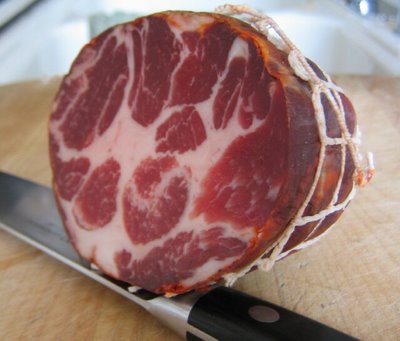
om nom nom
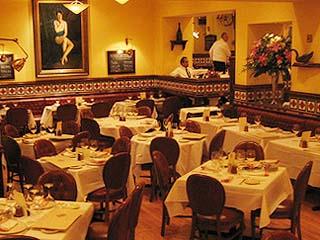 My recent post on Peter Luger reminded me of a trip to the Post House a few months back with my good friend Alex. Â Alex lives in California, but he makes a point of stopping at the Post House every time he swings through the city.
Nestled in Midtown, the sophistication that people might miss at Luger’s can be found in abundance at the Post House.  The establishment has a a rich, but simple, elegance that you would expect from a top end Manhattan steak house.  The table clothes are white, the waiters dote, and the clientele is suit clad.  And, as Alex likes to point out, this was one of Bernie Madoff’s favorite haunts.
I had the New York cut, which was, of course, everything that you can hope for in a steak.
Our sides consisted of the creamed spinach and asparagus. Â The creamed spinach was a clear home run. Â Unlike Peter Luger’s, the Post House’s creamed spinach has visible strands of spinach mixed with a thick cream sauce. Â (Luger presented creamed spinach that seemed to be whipped steamed spinach alone.)
But the coup de grâce was Alex’s order of the filet Oscar.  Wikipedia should have a picture of this bad boy under its entry for decadent.  The base is a huge melt in your mouth filet minion which is topped in crab meat, drowned (in the best sense of the word) in a Bearnaise Sauce, topped with chopped asparagus.  I’m sure this dish would infuriate a Peter Luger waiter, who seem to universally believe that a steak should, under no circumstances, be adulterated.  For my self, while I enjoy a great pure steak, this decadent tower of meat and seafood should be on everyone’s culinary bucket list.
In writing this, I learned that the Post House has a $24.07 dollar lunch prefix. Â I’m not sure that I’ll spring for the $10 extra for the filet Oscar, but given that this amazing deal is within walking distance from my office I’ll have to find an excuse to try this place again on the cheap.
 After trying Brooklyn Local One, I knew I had to get my hands on a bottle of Brooklyn Local Two.  The Local Two, a Belgian Strong Dark Ale with a 9.00% ABV, is a completely different beer from the Local One.
Appearance:  This beer is dark brown, like a well brewed coffee.  The head is extremely solid with a white/brown color.  Both the texture and appearance of head reminded me of a substantial foam on a cappuccino after its been stirred and taken on a slight coffee color.
(The coffee analogies end at appearance–there is no hint of it in the smell or flavor.)
Smell: Â Yeasty, like fresh bread or bread dough.
Taste:  It’s like a cinnamon roll without the cinnamon.  There is some mild yeasty tartness balanced with caramel flavor and a little sweetness.
Overall: Â It’s a good beer, but I’m just not head over heels for this style in general. Â If you like the style I’m sure you’d love this beer, but I’ll be keeping my eyes open for the Local One.
 To many, the name is synonymous with great steak.  Founded in 1887, Peter Luger is a New York institution that I had yet to experience.  Fayaz changed that by generously treating Nick and me for a passing the bar celebration.
On the night of our 8:45 Thursday reservation, Nick and Fayaz were running a little late and on Fayaz’s arrival we learned that he had made the reservation at the sister restaurant 140 miles away from the Brooklyn location.  This small error just meant we had to spend a little quality time at the bar.  After a proper negroni and solid gibson (think a martini with cocktail onions instead of olives) we got our table.
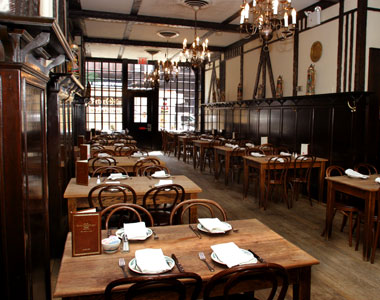 The dining room is simple, with bare wooden tables and humble decor, but feels as a steak house should.
Second only to Peter Luger’s reputation for amazing meat is it’s reputation for dismissive and and condescending servers.  I have to say that we experience none of the rumored poor service.  The only slight sneer we drew from our waiter was when Fayaz asked if the sauce on the table was the famous Peter Luger sauce.  (Despite having steak sauce in stores all over the city, Lugers hates the idea of you putting it on their steak.)  If I had to guess at the reason for the service reputation, I would point the finger at the customer.  Not only does some Minnesota nice and few please and thank yous go a long way, but I suspect that many first time Luger diners have miss placed expectations.  Yes, the place is expensive, but the menu is spartan and its simple food done really right.  I can see people coming in the door expecting pretense having their reality realigned by a server who’s seen it all.
And the food.  To start we ordered the Sliced Tomatoes & Onions and the bacon.  The Sliced Tomatoes & Onions are perfectly named, you get three huge slices of tomatoes and two large onion slices on a plate–that is it.  Our waiter recommended that we try it with a rust brown sauce sitting on a table in a gravy boat.  The sauce, their signature, reminded us of a cocktail sauce, not very sweet and heavy on the horseradish.  The sauce was great on the tomatoes and onion and delicious when sopped-up with bread.
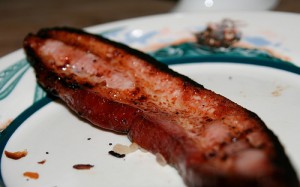
We ordered steak for three (yeah, that’s how you order it at Lugers) and it was [insert beefy superlatives].  It’s the best selection of meat that is dry aged on site before it’s butchered and cooked perfectly.  But, at the end of the day–and I know my grandfather is spinning in his grave as I type this–it was still steak.  I just don’t know if I’m able to tell the difference between a really good steak and an amazing steak.  The thick cut bacon, that little appetizer I didn’t elaborate on, was the home run when it came to the meat.  Fatty, but not overly so, this little bit heaven had prefect crisp on the outside and a smoky flavor that is still making me salivate as I think of it.  I felt like I was experiencing a whole smoked ham in every bit.  (To my vegetarian, Muslim, and Jewish friends: if you every change your mind run here and order several slices of this.)
For sides we took down the creamed spinach and the German potatoes.  The creamed spinach was unremarkable, but a necessary bit of color and texture for a plate of steak.  The German potatoes, not so different from home fries, were the prefect crispy starch that every good steak needs.  You can also get a baked potatoe (thank you Mr. Quayle) or french fries–I’m happy with our pick.
We decided to round the meal off with a tall ice cream Sunday that seems to hail from an old school ice cream shop. Â A prefect sweet ending to a great meal with a literal cherry on top.
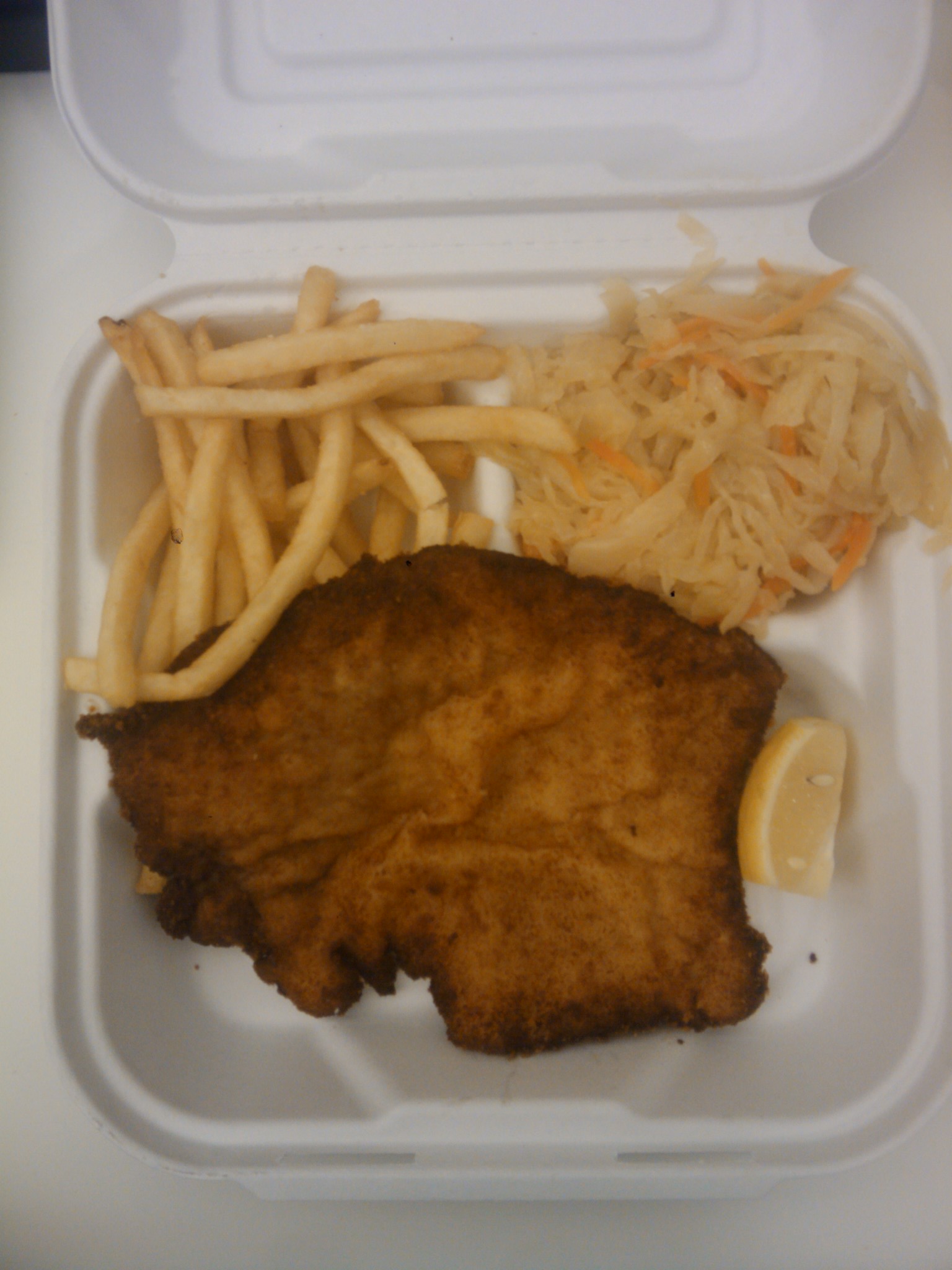 Today, I attempted to make a return to the Waffle Truck to satisfy my lunch time craving for a BBQ pork waffle. Unfortunately, the truck was no where to be found at its Tuesday location.  A quick twitter check revealed that the truck was stuck in the repair shop for a few hours.  Luckily the streets of New York are swarming with food trucks.  A few blocks later and I was standing in front of the Schnitzel and Things.
Perhaps not surprisingly, Schnitzel and Things offers up schnitzel… and things.  They actually have four different kinds of schnitzel and a bratwurst.  You can take the schnitzel down in either sandwich or platter form.  If you opt for the platter you can pick two items from a long tasty list of things (aka sides).  In case your not sure what schnitzel is: it’s piece of meat, pounded thin, breaded, and fried–so good!  Oh, and I almost forgot, the truck offers up an amazing array of condiments, including Spicy Sriracha Mayo and Ginger Scallion & Garlic Relish.
I went for the pork schnitzel, with fries, and sauerkraut with the sriracha mayo. Â It was a heaping amount of fried deliciousness. Â It was a little to heavy for lunch, actually it was just missing a beer, but I’ve just grazed the surface of this menu and will need to make a return trip.
 I have an embarrassing confession:  I don’t know where I live.  I tell people, with confidence, that I live in South Slope (aka South Park Slope).  With it’s amorphous borders, South Slope seems like a realtor’s invention to lure renters further into the heart of Brooklyn.  Some say that I’m in Sunset Park while others tell me I’m living in Windsor Terrace.
Where ever I live, it’s still New York–the land of bagel snobs, where a bagel store is never far off.  So it’s no small matter when I say that Terrace Bagels is my favorite bagel spot.
There is always a long line at this cash only establishment. Â Behind the counter is a crew of four or five weary looking souls. Â Every day it looks like at least one employee was up all night. Â Even if they are sleep deprived, they keep the line moving and the orders strait with a New York briskness and edge. Â Know what you want when you get to the counter. Â The attitude isn’t charming, it’s short, curt, and necessary to bring order to chaos and to keep the wait short.
The stereo typical New York service is well worth it for the bagels. Â They are exactly what a bagel should be, a fresh snappy doughy ring. Â (If it reminds you of bread it’s not a bagel!) And, unlike at Murray’s Bagel’s, you can get your bagel toasted. Â You can top your choice, from a wide selection, of bagels with a range of cream cheese flavors.
Whether it’s a solo bagel for me alone or a half dozen of em’ with a tub of cream cheese, I think that some of Terrace Bagels’ fine product makes it into the house on a weekly basis. Â With this place just a few blocks away, I’m happy to call 17th Street home, whatever anyone else wants to call it.



ABOUT
Good Food, Good Drink, Great Living
RECENT POSTS
| M | T | W | T | F | S | S |
|---|---|---|---|---|---|---|
| 1 | 2 | 3 | 4 | 5 | 6 | 7 |
| 8 | 9 | 10 | 11 | 12 | 13 | 14 |
| 15 | 16 | 17 | 18 | 19 | 20 | 21 |
| 22 | 23 | 24 | 25 | 26 | 27 | 28 |
| 29 | 30 | 31 | ||||
Tags
Archives
- November 2014 (1)
- October 2014 (2)
- September 2014 (1)
- April 2014 (1)
- March 2014 (1)
- February 2014 (1)
- January 2014 (1)
- December 2013 (4)
- November 2013 (2)
- October 2013 (1)
- September 2013 (1)
- August 2013 (4)
- July 2013 (4)
- June 2013 (6)
- April 2013 (5)
- March 2013 (5)
- February 2013 (1)
- January 2013 (3)
- December 2012 (2)
- November 2012 (13)
- October 2012 (4)
- September 2012 (6)
- August 2012 (3)
- July 2012 (4)
- June 2012 (6)
- May 2012 (10)
- April 2012 (13)
- March 2012 (5)
- February 2012 (5)
- January 2012 (2)
- December 2011 (16)
- November 2011 (8)
- October 2011 (10)
- September 2011 (10)
- August 2011 (12)
- April 2011 (2)
- March 2011 (8)
- February 2011 (7)
- January 2011 (7)
- October 2010 (5)
- September 2010 (8)
- August 2010 (12)
- July 2010 (5)